
Revenue Diversification for Non-Profits: What's Possible?
Webinar Summary
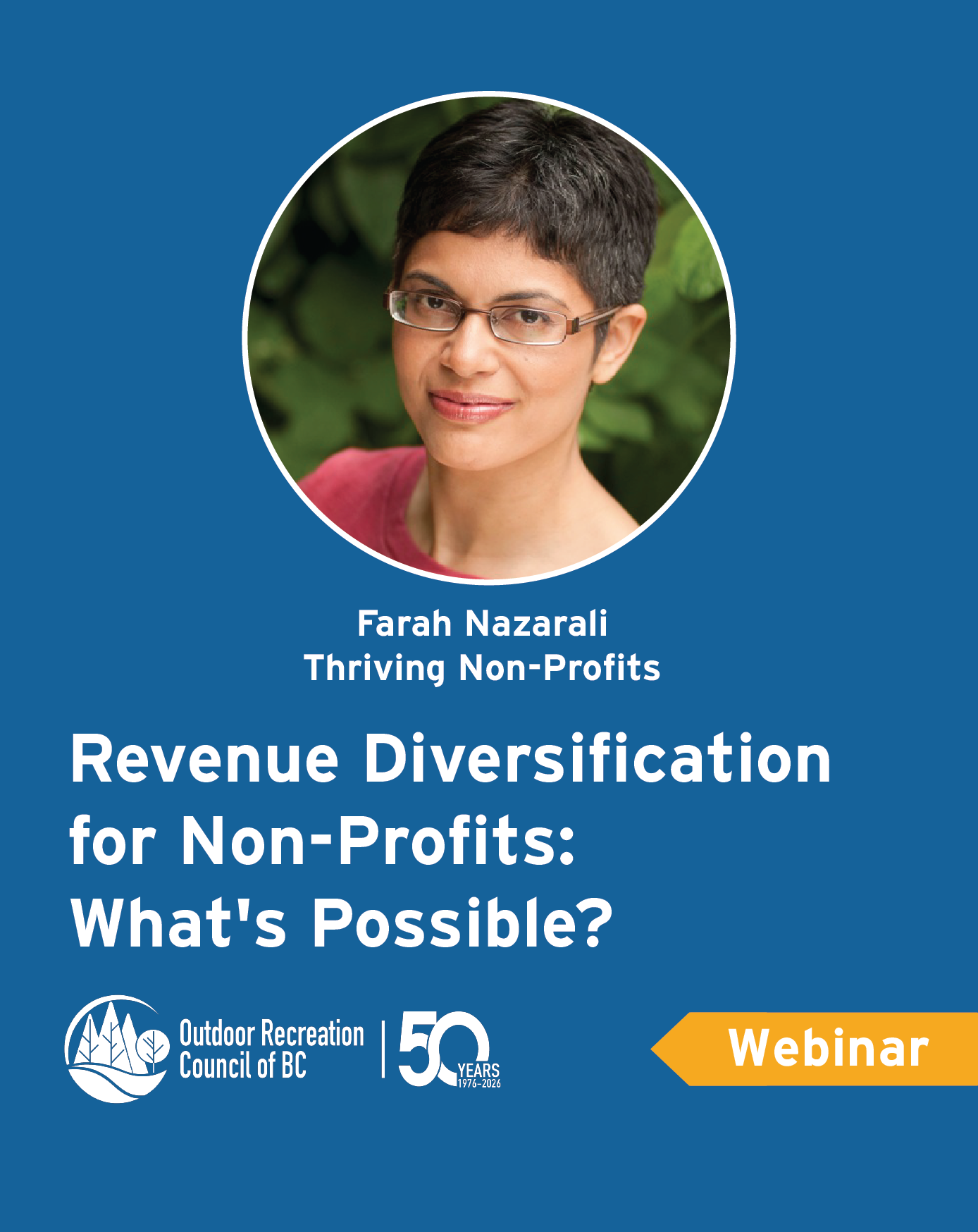
Traditional sources of non-profit funding are not keeping up. The path to financial sustainability is revenue diversification. This webinar shows you how.
One important thing: Maintaining sustainable funding is getting harder and harder. Government sources are falling behind inflation, there’s more competition for grants and other funding sources, operating costs continue to rise, and trends and technology shift the landscape, all while demand for outdoor recreation increases. The best path forward is to diversify funding sources with earned income.
The webinar: How to think like an entrepreneur was the focus of the ORCBC’s webinar on September 8. Thriving Non-Profit’s Farah Nazarali led a virtual workshop to introduce the organization’s approach to developing more resilient and sustainable funding models using the nine different revenue streams available to non-profit organizations.
The presenter: Farah Nazarali is the Program Facilitator for Thriving Non-Profits, a non-profit that trains leaders and executives in revenue diversification. The organization’s resources include an intensive cohort training program, self-paced courses, individual coaching and consulting, and, uniquely, they can help access values-aligned financing. Learn more on their website.
Thriving Non-Profits is offering a 50% discount on its Self-Paced Program to webinar registrants.
Use code: ORCBC
Connect with Thriving Non-Profits: hello@thrivingnonprofits.ca
Or schedule a free 30-minute consultation here.
The big challenge: Adopting a more entrepreneurial mindset requires changing the culture of an organization, which often leads to some resistance from boards, executives and staff. Concerns can include: risk avoidance, traditional way of operating, maintaining mission and equitable access, the upfront cost, and just an apprehension to doing things differently. Open, curious conversation is the best path to overcoming these concerns. And an equally open conversation about the risks of not changing.
Thriving Non-Profits has an Entrepreneurial Board Governance course. View the course here.
The nine revenue streams:
A growth or entrepreneurial mindset means developing as many diverse funding streams as possible. The more organizations move away from traditional funding sources, like donations and grants, the more discretion and control they retain over their finances, which leads to stronger, more independent organizations. Thriving Non-Profits breaks funding sources into two categories and nine total streams. They encourage applying entrepreneurial thinking to all possible sources.
Traditional sources:
Donations
Grants
Events - find as many revenue streams as possible beyond entry fees: food, silent auction, merchandise
Entrepreneurial sources:
Contracts - What are your expertise? Could you develop a business around your organization’s unique skills?
Eg: a conservation organization who contracts itself out for constructing stewardship projects.
Fee for service - Charge for experiences or to rent equipment you own.
- can remain equitable by using voluntary contributions, sliding scale, etc.
Eg: Businesses sponsor a trail managed by the North Shore Mountain Bike Club to cover maintenance costs.
Social enterprise - A separate or related business whose revenue are reinvested in the non-profit.
- start own business or buy existing one
- good timing: an estimated 80,000 business owners will retire in the next five to 10 years
- tax and social status implications
Eg: The Wild Bird Trust of BC operates a native plant nursery to help fund its operations.
Thriving Non-Profits runs a Social Enterprise Acquisition Course
Assets - owning something that can generate income.
- take a broad view: staff and volunteers, physical space, network, brand & goodwill, tools & equipment, waste streams
Eg: A sports club raised money using community bonds to build a club house where it other organizations can host summer camps, community meetings, workshops, etc.
Eg: Hotels sell used soap to a non-profit that uses them to make new soap it donates to the unhoused.
Partnerships - develop data and storytelling to show the value you bring to a partner.
Eg: Rocky Mountain Adaptive is helping government agencies be more welcoming to the disabled community.
Leverage - Align all your organizations operations so they match your values.
- Think: activities, employment, purchasing, banking and investment
- when you support other organizations that mirror your own, it lifts everyone up
Eg: More people want to come to your trail running race than can attend. How can you engage them as well?
First step to entrepreneurship:
Because every organization is unique there is no right path to a diverse and sustainable revenue system. Every organization needs to chart its own path by considering:
Time available
Culture of organization
Risk and return
Strengths and resources
Impact
Stay Connected
Don’t miss the next webinar! Stay up to date by subscribing to our newsletter. It’s the best way to hear about upcoming webinars, events or outdoor recreation news. Or follow us on Facebook, Instagram or LinkedIn.
Questions, comments, or webinar topics you would like to see? Email us at info@orcbc.ca
Support Our Work
As a non-profit organization, we rely on supporters to keep our programs, resources, and advocacy going so that BC can have enjoyable and responsible outdoor recreation opportunities. A tax-deductible donation today makes a big impact for the outdoors tomorrow.