
Rivers as reconciliation: Finding common ground in watershed stewardship
Webinar Summary
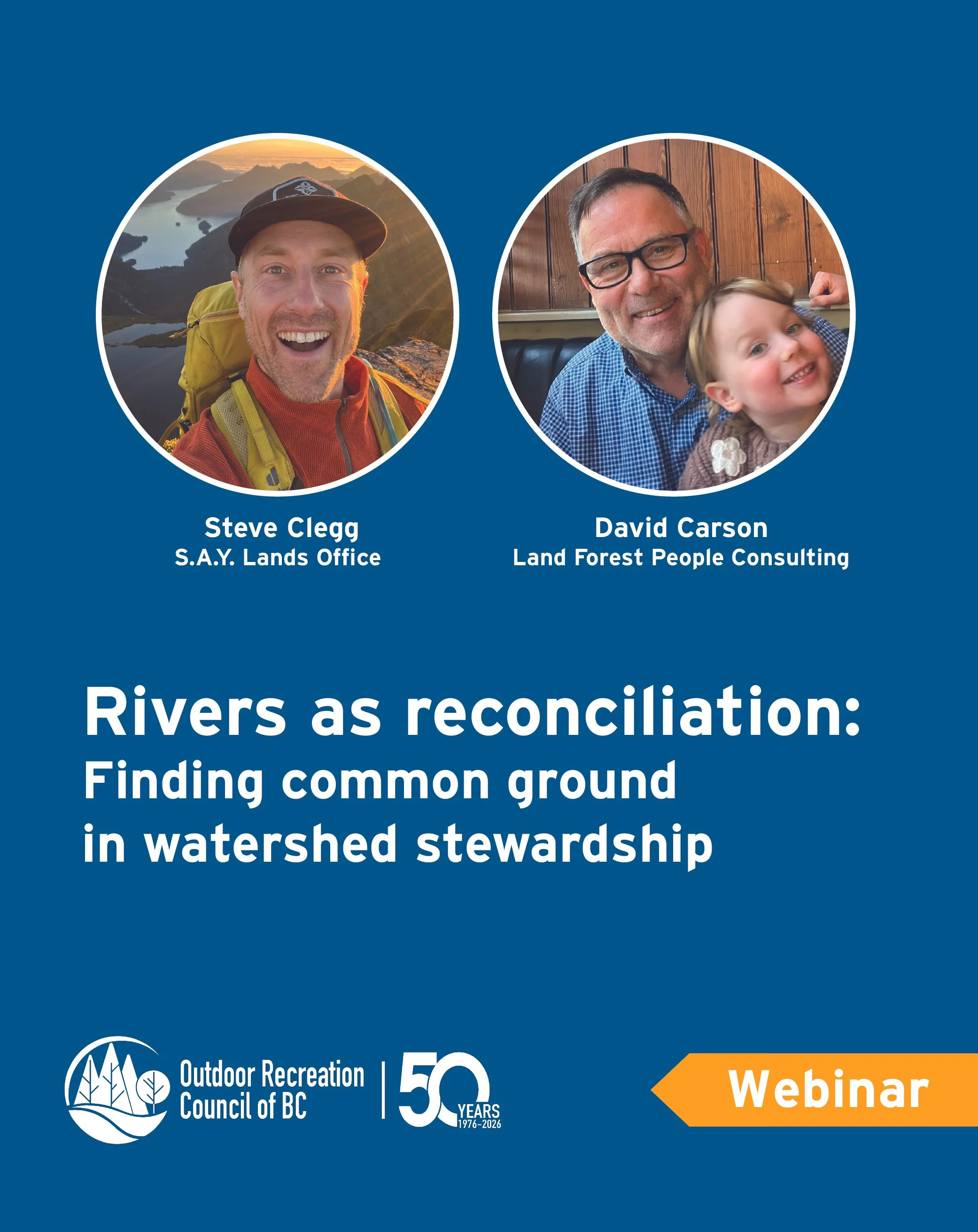
Reconciliation is a two way conversation and two B.C. First Nations are holding up their side of the discussion with action. That was the clear message from the ORCBC’s September 22 webinar, Rivers as reconciliation. It was timed to coincide with BC Rivers Day, which is this Sunday.
Panel
Steve Clegg, Land Stewardship Manager for S.A.Y. Lands & lead for the Ts’lhimexósem Trail. Steve.clegg@saylandsoffice.ca
Chrystal Gillingham, Vice-President for the Chilliwack Park Society, which helped with the Ts’lhimexósem Trail. chrystal@chilliwackparksociety.ca
David Carson, Registered Professional Forester (Land Forest People Consulting), working alongside the Χʷɛmaɬkʷu (Homalco) First Nation on Willow Creek restoration. davidmcarson@landforestpeople.com
Watch a recording of the webinar on ORCBC’s Youtube page.
What we learned
Caring for your neighbours
yiyχmɛštəm qʷaqʷtəm "we will take care of the creek" is a project on Homalco First Nation owned land that borders Campbell River. The desire to reduce flood risk to the community led to mapping the Willow Creek watershed and then restoration work, including installing fish-friendly culverts and beaver dam analogs.
Within a year of the work they found coho par in parts of the watershed where they haven’t existed for decades.
The project is at the top of the watershed and the work will also reduce flooding downstream in nearby communities.
The Homalco purchased land around the reserve, which is popular for recreation including trail use. Instead of restricting access, the Homalco decided it was in the spirit of reconciliation to welcome others to explore Homalco lands respectfully.
Good neighbour design
The Skowkale, Aitchelitz, and Yakweakwioose (S.A.Y.) First Nations used creative relationship building to welcome neighbours and the public to the Ts'lhimexósem (Going for a Walk Together) Trail.
The trail includes extensive restoration along Chilliwack Creek that protects species at risk and creates new salmon habitat.
The restoration work slowed the creek down with meanders, pools and woody debris.
The trail slows people down with viewing platforms, lending libraries with Indigenous books, walking stick and dog leash lending, natural playgrounds, and a meandering route. “It sets the tone for responsible recreation,” says Clegg.
The community partner
To the Chilliwack Park Society First Nations engagement is something they have always done, for instance, consulting with the Cheam First Nation on park names. They were involved in the Ts’lhimexósem Trail from the beginning, helping to move pedestrians off a busy street, rediscover an historic trail that followed the creek and contributing to the physical work.
Quotes
“Caring about the stream means caring about our neighbours downstream.” David Carson
“The most important way to take care of a place is to use it.” Stó:lō elder
“We watched the project morph from a blueprint for restoration to realizing what a riparian project can be: building community, protecting species at risk, bringing salmon back to a community. It’s beyond what we dreamed it could be.” Chrystal Gillingham
Other projects and trails mentioned during the webinar
Sts’ailes Heritage Traill: formerly the Chehalis River Fishing Trail, it’s a 5 km trail along the Chehalis River with cultural panels, viewing platforms and boardwalks.
Syéxw Chó:leqw (Rockslide in the forest): an adventure park and trail network built and managed by the Sq’ewá:lxw First Nation.
Thanks to the Real Estate Foundation of BC
We want to give a big thank you to the Real Estate Foundation of BC for supporting this webinar.
The Real Estate Foundation of BC funds projects, builds relationships, and shares knowledge to advance sustainable, equitable, and socially just land use and real estate practices across BC. REFBC is committed to supporting reconciliation with Indigenous Peoples and working in partnership with First Nations. In November, they published their inaugural Transformative Actions for UNDRIP Advancement progress report. Learn about how they are doing grantmaking, operations, and governance differently at REFBC.ca/TAUA.
Stay Connected
Don’t miss the next webinar! Stay up to date by subscribing to our newsletter. It’s the best way to hear about upcoming webinars, events or outdoor recreation news. Or follow us on Facebook, Instagram or LinkedIn.
Questions, comments, or webinar topics you would like to see? Email us at info@orcbc.ca
Support Our Work
As a non-profit organization, we rely on supporters to keep our programs, resources, and advocacy going so that BC can have enjoyable and responsible outdoor recreation opportunities. A tax-deductible donation today makes a big impact for the outdoors tomorrow.