
Lobbying 101: How to get you club’s priorities on the ballot this fall
Webinar Summary
In preparation for municipal elections on October 17, the ORCBC hosted a webinar to help the outdoor recreation community get the issues they care about on the ballot and on council agendas–without breaking the law. The webinar panel included elected officials and lobbying experts.
Speaker
Prairie Chiu, Director of Engagement and Advocacy, Vantage Point, pchiu@thevantagepoint.ca
Jennifer Cooke, Youth Engagement Coordinator, CPAWS-BC, jennifer@cpawsbc.org
Usoff Tsao, elected Director, Area A Wells Gray County, Thompson-Nicola Regional District, director.utsao@tnrd.ca
What we learned
Lobbying is an important part of democracy. It may not have a great reputation but it is how political candidates and elected officials learn about the issues impacting your community and their constituents. Outdoor clubs and non-profit organizations are allowed to lobby, but they must follow some important rules. Non Profit Power Up is a platform that generates custom toolkits to help organizations lobby and advocate more effectively: nonprofitpowerup.ca
Know the rules: There are a lot of regulations that govern the pre-campaign and campaign period in B.C. For charities there are potentially tax implications. For non-profits even advertising all-candidate forums and other meetings may require registering as a third party or lobbyist. Find out more from Elections BC and the Office of the Registrar of Lobbyists. Imagine Canada is hosting a webinar on this topic on September 2.
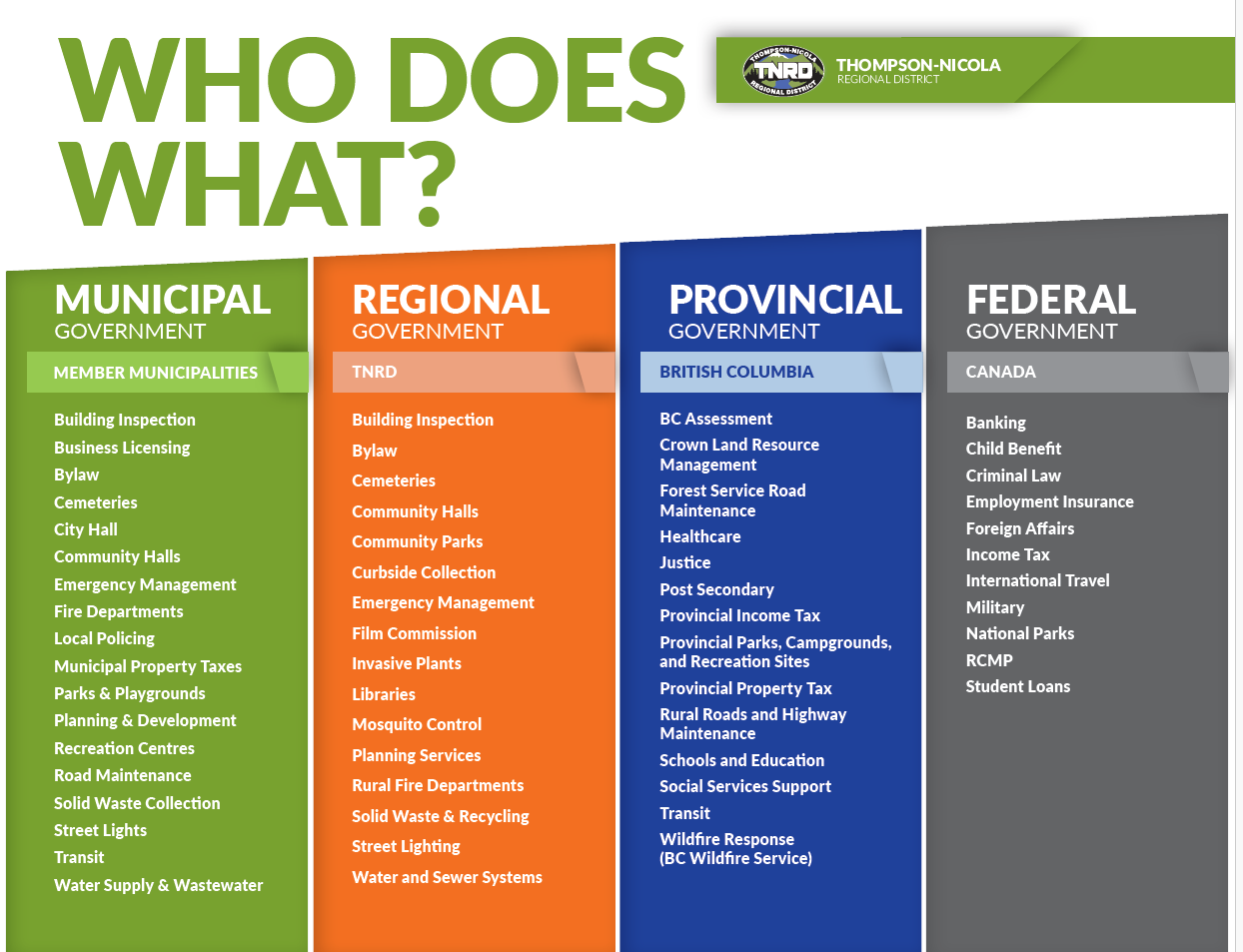
Do your homework: Before doing anything make sure you understand what each level of government is responsible for, so you are asking for the right thing from the right people. See the attached chart or this link. Also learn who your local elected officials are and who is running in this election. You can find out who your local elected officials are at civicinfo.bc.ca
Tip: Stay non-partisan. It may be required to retain charitable status. It’s also in the long term interest of your organization. By not picking parties or candidates specifically, you don’t alienate anyone and retain influence no matter who is in power.
Different forms of communication
There are many ways to engage with candidates and elected officials and different strategies for those meetings.
Direct meetings
Meeting with a candidate, either in person or with a letter.
In person: phone call, coffee
to understand their values and priorities
solicit their support with an issue (support publicly, bring to council meeting, talk with other councillors)
Letter: it should include five parts
Who you are: constituent, who you represent, etc.
Introduce the problem: what are the fats
Impact: how is it influencing the community
Solution: what you want them to do about it. ideas for solving the issue are more powerful than just stating problem.
Thanks: ask for a response
Tip: Letter like a pro. Letter writing campaigns are a good way to show the support for an policy. They are most effective when they are unique, but include the same facts and asks.
Presentation to council
Each community has its own guidelines and policies for securing a chance to speak to council. They are usually well communicated on the municipalities website.
Presentation to council: Keep it well within the time limit to allow time for questions. Send the councillors a brief several days before your presentation, so they have a chance to formulate questions. And plan to follow up afterwards with resources and updates. The presentation should include:
Who you are
The issue
Why the audience should care
Solutions
Thanks
Tip: Find allies. The more diverse the support for your solution, the more likely councillors will act on it. Think about other community groups who use your area of interest or share your values.
Public forums
Attending rallies, open houses, all candidates meetings and other events is a great way to learn the values and priorities of candidates. It’s also a great way to get them to commit to your priorities on the record. Prepare one or two questions in advance. Go early to get your name on the speaker list.
Tip: Develop a policy brief that you can provide to candidates. It should explain the issue you care about, how it impacts the community and how you think it can be solved. Tips on how to write a policy brief.
Think beyond the election
Lobbying and advocacy is an ongoing activity that should not end on election day. The months after the election are especially important. Be sure to congratulate elected officials and remind them of their commitments and your asks.
Get on the strategic plan: Early in a new mandate most municipal governments will develop a strategic plan. These priorities will dictate their actions for the next four years. Early in the new government mandate make sure the newly elected politicians know your priorities. Taylor your asks to align with the strategic plan.
Do the work for them: If you have a project you want the municipality to support get it ready to go. Hold open houses. Engage with First Nations. Gather data and impact. Being able to show a project has public support makes it easy for public officials to support it. Having shovel-ready projects are easier to approve when new funding opportunities appear.
Invite politicians to events: No one wants to be a party crasher. If you want them to come, invite them.
No does not mean failure: Don’t take a no to a funding request or policy change as the end. Investigate if there are other options, like pilots or feasibility studies. Ask why it failed. Learn, refine and continue.
Celebrate and publicize: When elected officials support you make sure to thank them publicly. It helps them show the impact of their decisions and how they spent the public’s money. It keeps your organization on their radar. And it smooths the way to future support.
Stay Connected
Don’t miss the next webinar! Stay up to date by subscribing to our newsletter. It’s the best way to hear about upcoming webinars, events or outdoor recreation news. Or follow us on Facebook, Instagram or LinkedIn.
Questions, comments, or webinar topics you would like to see? Email us at info@orcbc.ca
Support Our Work
As a non-profit organization, we rely on supporters to keep our programs, resources, and advocacy going so that BC can have enjoyable and responsible outdoor recreation opportunities. A tax-deductible donation today makes a big impact for the outdoors tomorrow.