
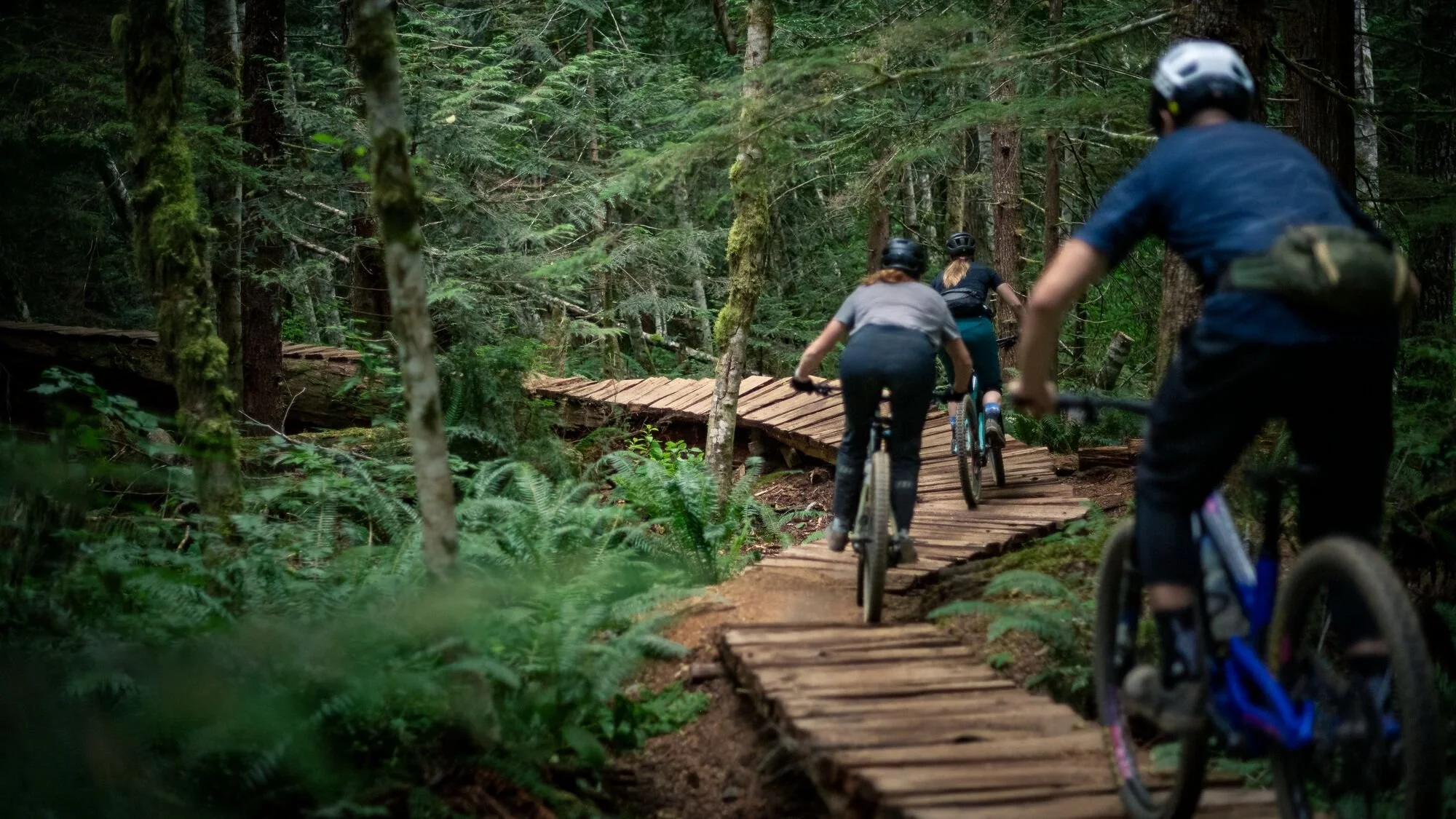
Working with private landowners to support trail access
Credit: Discover Comox Valley and Jarrett Lindal
Practical guidance for recreation groups working with private landowners to secure and maintain trail access.
Private land plays an important role in many trail systems across British Columbia.
Although it makes up a relatively small share of the province’s land base, private land is often located near communities, valley bottoms and transportation corridors. Trails may cross private parcels to connect neighbourhoods, recreation areas and surrounding Crown land.
For recreation groups, securing access is not just about finding the right route. It depends on permission, clear expectations and a relationship that can be maintained over time.
To support this work, the Outdoor Recreation Council of BC, in partnership with McElhanney, developed Best Practices for Developing Public Trails on Private Lands.
This article highlights some of the key lessons from that guide and from recreation groups across B.C.
Start with understanding
The public generally does not have a right to enter or use private land without the landowner’s permission or another legal right of access.
An existing trail, years of public use or a lack of signs does not necessarily mean access has been authorized.
Before approaching a landowner, take time to understand:
who owns the property and who has authority to make decisions
how the land is currently used
whether the land is leased or managed by another party
whether easements, rights-of-way or other agreements already exist
what access or trail work your organization is asking for
Different landowners will have different concerns.
On managed forest land, these may include harvesting, wildfire risk, road use, worker safety and reforestation. On agricultural land, concerns may include livestock, crops, gates, machinery, dogs, invasive species and biosecurity.
Showing that you understand the landowner’s needs is a better starting point than leading only with the benefits of the trail.
Relationships come before trails
Across B.C., successful trail access on private land is usually built over time. A landowner may be cautious about public access, particularly if it could lead to increased use, new infrastructure, or added responsibilities. Concerns may include wildfire risk, vandalism, illegal dumping, unauthorized camping, damage to gates or equipment, impacts to livestock or crops, and the cost of responding to problems.
Recreation groups can build trust by:
listening carefully to concerns
being clear about the proposed use
explaining who will be responsible for the trail
responding quickly when issues arise
following through on commitments
accepting that some locations may not be suitable
In Rossland, the Kootenay Columbia Trail Society worked over time to secure permission for trails crossing private land. The organization focused on areas where productive relationships could be built rather than assuming access would be possible everywhere.
In Cumberland, the United Riders of Cumberland has worked with private landowners, forestry companies, the municipality and other partners across a complex mix of land ownership.
These examples show that lasting access rarely comes from a single request. It grows from regular communication and a willingness to adapt.
Put agreements in writing
For organized public use, trail construction or ongoing maintenance, written permission or a formal agreement is strongly recommended.
A clear agreement helps both the landowner and the recreation group understand what has been approved and who is responsible for what.
Depending on the situation, an agreement may cover:
the trail location and permitted uses
construction and maintenance responsibilities
trail standards and inspections
signage and public information
insurance requirements
seasonal or temporary closures
incident reporting
the length of the agreement
renewal and termination
what happens to trail structures if access ends
The trail route should be accurately mapped and attached to the agreement where possible.
Because these agreements may involve legal obligations, insurance and the allocation of risk, groups should consider getting legal advice, particularly for long-term or more complicated arrangements.
Do not rely on historic use
Some trails have crossed private land for decades without a formal agreement.
That history may help explain the importance of the route, but it should not be treated as proof that public access, maintenance or new construction is authorized.
Informal access can become vulnerable when:
the property changes ownership
recreation use increases
land-management activities change
a safety concern arises
the trail is promoted online
volunteers begin doing more substantial work
Formalizing access can provide more certainty, but the landowner may also decide not to continue allowing public use. Recreation groups should be prepared for that possibility and avoid treating access as an entitlement.
Understand liability, insurance and risk
Liability is often one of the first concerns raised by private landowners.
B.C.’s Occupiers Liability Act provides some protection for landowners who allow certain unpaid recreational uses. However, those protections are not absolute and depend on the circumstances.
Landowners and recreation groups should not assume the legislation removes all risk.
Risk can be reduced through:
appropriate trail design and construction
regular inspections and maintenance
records of inspections and completed work
clear signs and closure notices
trained and supervised volunteers
prompt responses to known hazards
suitable insurance coverage
Landowners may require a recreation group to carry liability insurance and, where appropriate, name the landowner as an additional insured.
Groups should check with their insurer to confirm what is covered, including volunteer work, trail construction, events and organized programs.
Be clear about use and boundaries
Permission to cross private land is rarely unlimited.
A landowner may restrict:
certain types of recreation
dogs or motorized use
parking
organized events
commercial activity
access during forestry or agricultural operations
use during certain seasons
Accurate mapping and clear signs can help users understand where they are allowed to go and what conditions apply.
Online trail information also needs to be kept current. A route should not continue to be promoted as open when permission has been withdrawn, or a closure is in place.
Trail agreements should also recognize that landowners may need to carry out harvesting, farming, utility work or other activities. These operations may require temporary closures, reroutes or changes to the trail.
Discussing these possibilities early can prevent misunderstandings later.
Maintain the relationship
A signed agreement is not the end of the process. Access depends on regular communication and attention over time.
Good practices include:
checking in with the landowner
sharing updates on maintenance and trail use
providing current insurance documents
giving advance notice of planned work
reporting incidents promptly
responding quickly to concerns
reviewing agreements from time to time
updating contacts when staff, volunteers or ownership changes
A landowner should not hear from the recreation group only when there is a problem or a new request.
When concerns arise, stop any disputed work, listen carefully and focus on finding a practical solution.
Plan for change
Private-land access may not last forever. Ownership can change. Land use can shift. A preferred trail alignment may no longer be possible.
Strong trail organizations plan for this by:
focusing on willing landowners
identifying possible alternative routes
maintaining accurate maps and records
securing formal rights-of-way where appropriate
working with local governments
avoiding over-reliance on a single critical parcel
Being flexible does not mean giving up on long-term access. It means recognizing that a trail must work for the landowner as well as the recreation community.
Final thoughts
Private land is essential to many trail networks in B.C., particularly near communities and where trails connect different destinations.
Public access across private land should never be taken for granted. It depends on permission, clear expectations and a relationship that is maintained over time.
Done well, these partnerships can:
protect important trail connections
give landowners greater confidence
clarify responsibilities
reduce conflict
support more stable public access
Done poorly, or without permission, trail use and maintenance can damage relationships and lead to access being withdrawn.
Long-term trail access on private land is built through trust and ongoing relationships.