
50 year pay off. As it prepares for its golden anniversary, ORCBC looks back on a big year
Like athletes timing their Olympic peak, 2025 was a year of building towards a major milestone for the Outdoor Recreation Council of BC. In May 2026, the non-profit will celebrate 50 years of advocating for recreational access to land and water on behalf of all British Columbians.
“Looking back on 2025, I think we’ll see it as a turning point for outdoor recreation in the province,” says Louise Pedersen, the executive director of the ORCBC. “This year, we really started to see recognition for the positive impact outdoor recreation has on everything from mental health to economic development. It sets us up for the important conversations we’ll be having in 2026, particularly at our anniversary conference.”
The highest-profile event of 2025 might have been the release of a provincial government study that found that outdoor recreation contributed more than $4.8-billion to the B.C. economy in 2023.
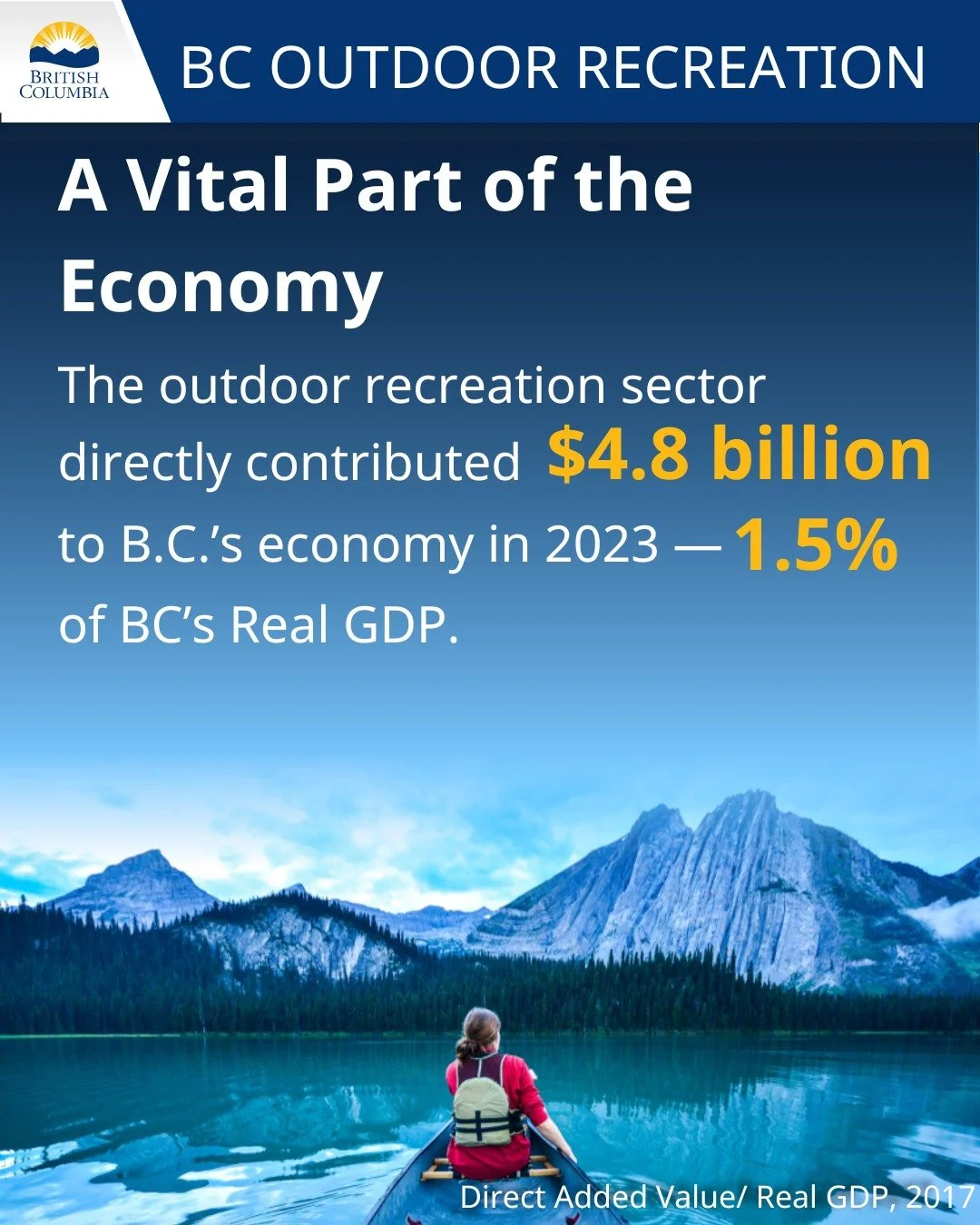
The ORCBC encouraged the provincial government to conduct the research and helped amplify the release of the data with a social media campaign on Instagram and Facebook. Now the province says it plans to expand the study to better understand the whole impact of outdoor recreation on the economy.
That growing recognition was also reflected in provincial economic policy. Outdoor recreation was explicitly acknowledged in B.C.’s Look West economic strategy, which highlights the sector’s role in supporting regional economic growth, community resilience, and quality of life as the province strengthens trade and investment ties with Asia-Pacific markets.
The provincial data supported the ORCBC publication, Outdoor Recreation for Community and Economic Development: A Guidebook for Rural British Columbia Communities. Produced by the ORCBC in 2025 with help from researchers at Selkirk College, it’s a practical and interactive guidebook for communities interested in leveraging outdoor recreation for economic resilience, community wellbeing and environmental stewardship. The ORCBC presented the guidebook to dozens of communities across the province at conferences, via virtual presentations, and in a webinar.
The ORCBC also produced Outdoors for All: An Inspiration Guide for Creating Welcoming Outdoor Recreation Spaces. The publication is a collection of case studies and advice that show that working to make outdoor recreation more inclusive benefits everyone. The guide was generously supported by the BC Parks License Plate Program.
Beyond the inspiration guide, improving access to recreation was a major theme of the ORCBC’s other work in 2025.
ORCBC members continued their interest in developing stronger relationships with First Nations. Of the 10 webinars the ORCBC organized in 2025, the Indigenous themed ones (recreation and Indigenous tourism and the importance of archaeological surveys), were the best attended. To support the members in this work, the ORCBC Reconciliation Committee released a framework document.
Both of the ORCBC’s events, BC Trails Day and BC Rivers Day, encouraged everyone in the province to get out and be active in nature. For the June Trails Day, 48 communities across the province held more than 60 events, everything from trail work to gear swaps. BC Rivers Day engaged even more people: 5,400 to BC Trails Day’s 4,300 plus. The September river-focused events–river stewardship, education and recreation–included 83 organizations.
The widespread popularity of these days hints at the continued popularity and interest in outdoor recreation across the province. Data from the Outdoor Recreation Fund of BC puts hard numbers to it. The ORCBC manages the granting process for the $10-million endowment fund, and 2025 was the second intake. This year, the fund handed out $255,000 in grants to 32 projects that will positively impact 39 communities.
Mirroring the 2024 intake, the fund was heavily oversubscribed in 2025. In the fund’s two grant cycles it has received 410 applications requesting more than $3.4-million. Applications to the fund’s 2026 intake are open now through January 20, 2026.
“I think the interest in the fund shows how important outdoor recreation is to British Columbians and how all levels of government need to do more to support the clubs and associations who really make recreation possible and accessible in the province,” says Pedersen.
There are plenty more numbers that speak to the ORCBC’s advocacy and support for outdoor recreation in 2025. But the numbers Pedersen is most proud of is its membership.
“When a new club joins this organization, it really shows me the work we are doing matters and is making a difference,” she says.
ORCBC now represents 102 regional clubs (mountain bike clubs, off-road dirt biking groups, conservation organizations, etc.) and 19 provincial associations and federations (groups like ATVBC, the BC Snowmobile Federation, Crosscountry BC BC Wildlife Federation, the Backcountry Horsemen of BC and the Lapidary Society of BC, who each represent many regional clubs). Adding up all the people who are members of all these different groups means the ORCBC represents about 200,000 British Columbians.
Those numbers represent a benchmark in the ORCBC’s nearly 50-year existence, says Pedersen. And that makes the organization’s conference an important meeting for the future of outdoor recreation. In May, the whole community will come together in Kamloops for the 2026 ORCBC Conference: Building Stronger Communities Through Outdoor Recreation. It will be a chance to set the community up for future success and celebrate what was achieved in 2025 and over the last five decades.
“Everything we accomplish at the ORCBC can be traced back to the thousands of volunteers who have worked so hard to create outdoor recreation opportunities in B.C. last year and over the last 50 years,” Pedersen says. “I believe all their hard work is really starting to pay off.”