
ORCBC Reconciliation Committee releases a framework to engagement
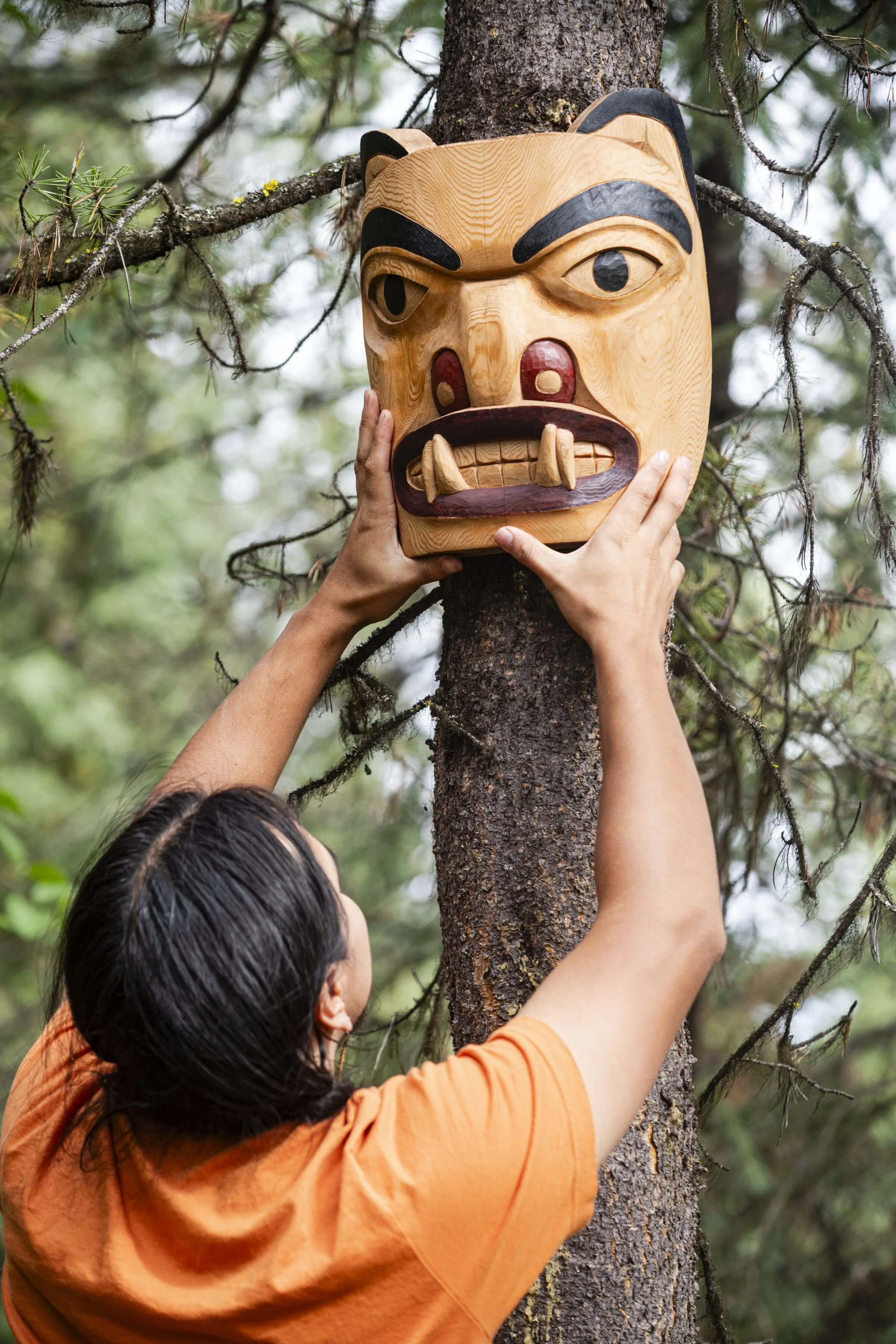
Carver and artist Kobe Antoine of Lake Babine Nation and his instalment at the Kager Lake Mountain Bike Trails in Burns Lake. Image credit: Northern BC Tourism & Mattias Fredriksson.
What reconciliation is all about
"We have described for you a mountain. We have shown you the way to the top. We call upon you to do the climbing."
These are not the words of a mountain guide inspiring climbers, but rather the Honourable Murray Sinclair, the Chair of Canada’s Truth and Reconciliation Commission. Many of the commission’s “calls to action” urged all Canadians to get involved in reconciliation. In other words, citizen-based reconciliation.
This is also the foundation of the Outdoor Recreation Council of BC’s Framework for Indigenous Reconciliation in Outdoor Recreation. Developed by the ORCBC’s Reconciliation Committee, the Framework is not a prescription, but rather a guiding document for how the organization will approach reconciliation and support its members in the work.
The Framework recognizes past injustices, acknowledges Aboriginal rights and title, and reaffirms the ORCBC’s commitment to advocate for access to recreation for all British Columbians. The focus, though, is on encouraging members to heed Sinclair’s words. Rod Clapton, the chair of the ORCBC Reconciliation Committee, says the committee is calling it Citizen-based Reconciliation.
“What we’re saying is ‘get involved,’” he says. “Reconciliation should be the initiative of all Canadians and all members of the ORCBC. It doesn’t have to be something big. It’s amazing what can be accomplished with a simple cup of coffee with an individual.”
Clapton, the president of B.C. Federation of Drift Fishers (BCFDF), is speaking from experience. When conflicts between First Nation fishers and sport anglers got physical on the Lower Fraser River, Clapton asked a couple of Indigenous representatives to coffee.
“You can get a hell of a lot more done face-to-face,” he says.
Sitting across from each other, everyone quickly realized they shared the same goals: ensuring their grandkids would have access to the same experiences on the river they had enjoyed. Coffee eventually led to the Lower Fraser Collaborative Table, a venue where sport fishing groups, commercial fishermen and 30 First Nations in the Lower Mainland meet to discuss fishing issues and make recommendations to the federal government. He says three key ingredients make it possible: respect, tolerance, and patience.
Indigenous people involved in the collaborative table tell Clapton that human-to-human engagement is the most meaningful form of reconciliation.
Patience may be the most important of the three, says Norman Marcy, a member of the ORCBC Reconciliation Committee and a member of the BC Marine Trail (BCMT). The organization is developing paddling routes along the B.C. coast by practicing Citizen-based Reconciliation.
Since 2018, BCMT has approached about 70 First Nations with traditional territory on the coast. Some were enthusiastic partners. Others have been slower to engage. For instance, the Mowachaht-Muchalaht First Nation didn’t respond to the BCMT’s overtures for several years. Then, suddenly, this year, they asked the BCMT to contribute to their tourism strategy.
“This has happened a number of times,” says Marcy.
The BCMT now has relationships with 50 Nations, and the benefits flow both ways.
“Our organization’s ability to grow and develop is based on the good work we have done with First Nations,” Marcy says, noting it has spurred donations and funding opportunities that wouldn’t have been possible otherwise.
He hopes the Reconciliation Framework will do two things. First, encourage ORCBC members to develop or strengthen their relationships with the local First Nation or Nations, and, second, serve as an invitation to reach out to members of the Reconciliation Committee if they need help or advice. (He recommends members read the book Reconciliation in One Minute. The ORCBC has also produced several resources to help its members with Indigenous relationships and reconciliation. An extensive list with links is below.)
The hardest step for many is often figuring out how to begin, says Rocky Nenka, an Indigenous Tourism Specialist with Tourism BC, an ORCBC Board Member, and a person of Indigenous descent from the Beaver First Nation in northern Alberta.
“I hope this framework provides some clarity and guidelines in keeping focused and respectful conversations in a constantly changing environment,” he says.
He joined the Reconciliation Committee after seeing the hard work they had put into the Framework. In particular, he thinks the last line of the document is important: “True reconciliation requires everyone to seek meaningful ways to contribute.”
“I think the keyword there is everyone,” he says. “We all have a part to play, and that includes both our Indigenous and nonindigenous partners and friends. This framework can help to provide some direction to do that, ‘In a good way’.”
That’s a sentiment Sinclair would agree with.
"I really don't care if you feel responsible for the past,” Sinclair said. “The real question is, do you feel a sense of responsibility for the future? Because that's what this is all about."
ORCBC Indigenous Relationship Building Resources
A comprehensive list of resources, blog posts and webinars related to First Nations engagement.
Resources:
The ORCBC has created two comprehensive documents designed to help members start and nurture relationships with First Nations.
Guidance Toolkit for Engagement with Indigenous Communities: Tools for recreation organizations embarking on discussions and relationship building with First Nations at the community level.
Working in a Good Way: A best practices guide for engaging and working with Indigenous Peoples on trails and outdoor recreation projects in BC. Produced by ORCBC in 2019
Blog posts:
Indigenous related blog posts live at orcbc.ca/Indigenous-Relations
Webinars:
The ORCBC’s monthly webinars often discuss Indigenous related topics.
Integrating archaeology and Indigenous partnerships in trail planning, November 2025
Recreation and Indigenous tourism, March 2025
Indigenous Protected and Conserved Areas, November 2024
Reconciliation and Recreation: Advice and Lessons from Outdoor Groups, March 2024
Reconciliation and recreation: Indigenous Perspectives, January 2024
Indigenous Land Protocols, November 2022
ORCBC Reconciliation Committee
To get in contact with the ORCBC Reconciliation Committee or to learn more about what it’s working on, contact ORCBC.